Latest News

Showing posts with label Machine Learning. Show all posts

Monday, October 19, 2020

Sharing patient data by applying machine learning in hospitals

Federated learning is a new and promising approach to make the adoption of machine learning and patient data sharing possible in the medical field.


Despite the widely popular application of AI and Machine Learning across industries, the healthcare sector always hesitates to embrace the technology of the future due to privacy problems. The concern for patient confidentiality has always been the dilemma impeding the adoption of machine learning or the potentials and the power to transform the healthcare landscape.


Sharing patient data by applying machine learning (Photo: HealthCatalyst)


Federated learning comes as the solutions for the dilemma as the technology generates almost identical results as the method that is not protected does. Federated learning was first used by Google to train an algorithm through several decentralized computers containing local data samples, without sharing them. And the method shows great potentials in brain imaging,  analyzing magnetic resonance imaging (MRI) scans of brain tumor patients and distinguish healthy brain tissue from cancerous regions.


For instance, doctors in different parts of the world can enter their patient scan data, training on a shared model, then the new model will be transferred to a centralized one. By doing that, the model has gained the knowledge front he hospital and generate useful clinical data.  "Traditionally, machine learning has used data from a single institution, and then it became apparent that those models do not perform or generalize well on data from other institutions.", said Spyridon Bakas.


In regard to tumor boundaries, Bakas the opinion not only varies from person to person but also differs from one day to another of the same doctor. "Artificial Intelligence allows a physician to have more precise information about where a tumor ends, which directly affects a patient's treatment and prognosis.". He said.


In the research to study the effectiveness of the new technology, the outcomes that have been produced by federated learning are little to no significant differences compared to the other methods. The technology opens a new promising field that needs more study, expanding the application of the use cases and industries other than healthcare.


Source: Science Daily.


About us: TMA Solutions was established in 1997 to provide quality software outsourcing services to leading companies worldwide. We are one of the largest software outsourcing companies in Vietnam with 2,500 engineers.

Visit us at https://www.tmasolutions.com/


Wednesday, September 23, 2020

3 types of AI: a guide to narrow, general, and super artificial intelligence (part 1)

Part 1 of this article will go through a brief overview of Artificial Intelligence and the first type of AI.


Narrow or weak AI, general or strong AI and artificial superintelligence are the three types of artificial intelligence (AI).


Right now, we have only achieved narrow AI. As machine learning capabilities continue to develop, and scientists are getting closer to achieve general AI in the near future.


3 types of AI: a guide to narrow, general, and super artificial intelligence (Photo: accilium)


Artificial Narrow Intelligence (ANI) / Weak AI / Narrow AI


The only successful form of AI that has been implemented today is Artificial narrow intelligence (ANI), also known as weak AI or narrow AI. Though Narrow AI is excellent at completing specific tasks such as facial recognition, speech recognition/voice assistants, driving a car, or searching the internet, it is meant to perform singular tasks.


Intelligent as these machines appear, they only simulate simple human behaviors and function under a limited range of constraints. The fact that Narrow AI does not imitate or replicate human intelligence and work on a restricted set of parameters and contexts makes them a weak type of AI. The applications of this type can be seen at the speech and language recognition of the Siri on iPhones,  vision recognition of self-driving cars, and recommendation engines that make suggestions based on purchase history.


In the last decade, Narrow AI has undergone several breakthroughs, propelled by advancements in machine learning and deep learning. AI systems are now used in medicine to diagnose cancer and other diseases with a high degree of precision by emulating human cognition and reasoning.


Natural language processing (NLP) emerges in the Narrow AI's machine intelligence which recognizes speech and text in chatbots. Hence, AI is designed to communicate with humans in a natural, personalized way.


Narrow AI consists of reactive AI which has no memory or data storage to simulate human responses to things and limited memory AI which can use historical data to make decisions with equipped learning capabilities. The vast majority of AI nowadays is limited memory that utilizes deep learning technology to personalize users’ experience.


Source: Codebots


About us: TMA Solutions was established in 1997 to provide quality software outsourcing services to leading companies worldwide. We are one of the largest software outsourcing companies in Vietnam with 2,500 engineers.

Visit us at https://www.tmasolutions.com/

Monday, September 7, 2020

How to make AI trustworthy

One of the biggest bottlenecks when adopting new technologies is trust in AI. Now, a new tool generates automatic indicators if data and predictions generated by AI algorithms are trustworthy.


Neural networks are a type of artificial intelligence that is modeled after the brain and generate predictions. But how we can tell these predictions are trusted? One of the key barriers to the adoption of self-driving cars is that the vehicles need to act as independent decision-makers in the road. Can we trust the computer software within the vehicles to make sound decisions within fractions of a second - especially when conflicting information is coming from computer vision from cameras or data from lidar? Even humans can be indecisive in certain cases involving conflicting information.


Knowing which systems to trust and is most accurate would be helpful to determine what decisions 

the autopilot should make (Photo: aitrends)


A new tool developed by USC Viterbi Engineering researchers named DeepTrust can quantify the amount of uncertainty, should human intervention is necessary. It took the research team almost two years to employ what is known as subjective logic to assess the architecture of the neural networks. On one of their test cases, DeepTrust found that the prediction pointing towards Clinton winning in 2016  Presidential election had a greater margin for error.


The other significance of this research is that it provides insights on how to test the reliability of AI algorithms that are normally trained on thousands to millions of data points. In other way, how to make sure the architecture of these neural network systems has greater accuracy. This work could also serve as a guidepost as to how much "noise" can be in testing samples if computer scientists want to maximize accuracy and trust.


This model is the first of its kind. To our knowledge, there is no trust quantification model or tool for deep learning, artificial intelligence, and machine learning. DeepTrust has the potential to make AI aware and adaptive.


Source: ScienceDaily


About us: TMA Solutions was established in 1997 to provide quality software outsourcing services to leading companies worldwide. We are one of the largest software outsourcing companies in Vietnam with 2,500 engineers.

Visit us at https://www.tmasolutions.com/


Thursday, September 3, 2020

Combination Of AI & Blockchain - The Revolution Of Financial Industry (Part 2)

This part will cover the last three factors when combining Blockchain and Artificial Intelligence in the financial industry. 

    4. A Unique and Financial Trust system

In 2017, after the dramatic drop in Bitcoin's price value and the failure of so many ICO projects, lots of investors started losing trust in cryptocurrencies, which are backed by blockchain. Recently, there is a new blockchain-based solution named DYCO (Dynamic Coin Offerings) – a crowdfunding model designed to offer a guarantee of refunds and protection upon any investment made on any blockchain project, according to Entrepreneur.com. This model can help potential investors scrutinize project whitepapers and choose ICOs with the highest profit potential. Moreover, it helps eliminate any chances of losing your whole invested fund.


Blockchain is inherently perfect for storing highly confidential information because of its immutability features that can’t be altered.  And the application of Artificial intelligence, on the other hand, will help financial companies to boost their income, efficiency, provide detailed insight about data and manage risk as well. Therefore, by combining the unique features of both AI and blockchain, it’s logical to say that there will be a much promising trust system in the financial industry.


    5. Analyzing and Understanding AI Decisions

One of the factors that limit the mass adoption of artificial intelligence is its complexity in interpretation - AI can evaluate many variables unaided. That's the reason why many people won't implement it if they can’t clearly explain computers' decisions, especially when it comes to financial transactions that require thorough investigation.


However, there is existing proof that humans could tamper with the recorded data set for analysis, which is one of the main reasons people are still in doubt when it comes to processing financial transactions.


The combination of blockchain and AI help people disentangle the complexity by making computers to be more transparent. Blockchain is an underlying technology that is known for transparency and immutability. Blockchain can store every decision made by AI and still make them available for analysis, so people can be sure that any financial record or information from entry to examination/audit is tamper-proof.


    6. The challenges when applying Blockchain and AI

Blockchain is known as a decentralized technology capable of bringing solutions to centralized systems, e.g., banking. However, some people see it as a threat to the original will of decentralization when it's being merged with artificial intelligence/ machine learning. This is one of the possible challenges that developers are tirelessly working on solving.


Besides, AI requires access to a pool of data, and incorrect data can ruin both machine learning blockchain technology's integrity and effectiveness. While there are ways to resist erroneous data, it’s still an ongoing obstacle to solve.


Source: DZone


About us: TMA Solutions was established in 1997 to provide quality software outsourcing services to leading companies worldwide. We are one of the largest software outsourcing companies in Vietnam with 2,500 engineers.

Visit us at https://www.tmasolutions.com/

Machines can now learn unsupervised at 'lightspeed' after AI breakthrough, scientists say

According to research published in Applied Physics Reviews, the performance of photon-based TPU is 100 times higher than that of the electrical processor.

This new approach enhances not only the speed but also the efficiency of machine learning neural networks significantly. Current processors used for machine learning have certain limitations in performing complicated operations due to the power required to process the data. The more demanding the task, the more complex the data, therefore the greater the power requires. In addition, these networks are also limited by the slow transmission of electronic data between the processor and the memory.

Elite U.S. researchers discovered that using photons within the neural network (tensor) processing units (TPUs) could overcome these limitations and create more powerful and power-efficient AI. In addition, their photon-based TPU was able to perform between 2-3 orders of magnitude higher than an electric TPU.

By replacing electricity with light-based TPU, machines now can learn unsupervised at a speed of lightning. (Photo: Analytics Insight)

“We found that integrated photonic platforms that integrate efficient optical memory can obtain the same operations as a tensor processing unit, but they consume a fraction of the power and have higher throughput,” said one of the paper’s authors. “When opportunely trained, [the platforms] can be used for performing interference at the speed of light,” he added.

Potential commercial applications for the innovative processor include 5G and 6G networks, as well as data centers tasked with performing vast amounts of data processing. Photonic specialized processors can save a great deal amount of energy, improve response time, and reduce data center traffic to a significant amount.

Source: Independent UK

About us: TMA Solutions was established in 1997 to provide quality software outsourcing services to leading companies worldwide. We are one of the largest software outsourcing companies in Vietnam with 2,500 engineers.

Visit us at https://www.tmasolutions.com/

Tuesday, September 1, 2020

Assessing the performance of surgeons by scanning their brain

The researchers have researched and developed a deep learning AI tool called Brain-Net that can rely on surgeons' neuroimaging data to accurately predict their certification scores.

Objective assessments of surgeons' surgical skills are determined through certification scores, known as the Fundamentals of Laparoscopic Surgery program (FLS). The certification score demonstrated effective training is calculated manually using a formula that consumes effort and time. 

Researchers have applied nationally The Fundamental of Laparoscopic Surgery program for medical subjects including surgical residents, fellows, and practicing physicians with the aim of learning and practicing endoscopy, enabling them to measure and document those skills. Besides, the time of the surgical task execution, as well as error estimation, are the scoring platform, which is one of the crucial aspects of this program. 

AI can predict a surgeon’s certification scores based on their neuroimaging data. (Photo: News Punch)

Thanks to a simultaneous neural network from using optical imaging of the human brain, the team of researchers were able to accurately predict the FLS score of surgeons. They used functional near-infrared spectroscopy (fNIRS) data which is effective in categorizing different motor tasks, to predict the final performance score used in the surgical certification. These outcomes are a premise to improve surgical skill acquisition, retention, and the certification process by utilizing neuroimaging and deep learning for neurofeedback. While current approaches only concentrate on task repetition without the potential for fast and objective feedback, these new approaches can enable a more personalized training regimen with bedside responding for optimal skill acquisition.

The neuropsychiatry of surgeons is a way to improve the way their surgical skills are taught and evaluated, thus laying the foundation for new improvements in surgical mission performance and personalized training methods in the future. Moreover, researchers also hope future studies will be able to find a new arrangement of neuro biomarkers that give a better understanding of surgical skill learning and execution.

Source: Digitaltrends

About us: TMA Solutions was established in 1997 to provide quality software outsourcing services to leading companies worldwide. We are one of the largest software outsourcing companies in Vietnam with 2,500 engineers.

Visit us at https://www.tmasolutions.com/


Friday, August 28, 2020

Combination Of AI & Blockchain - The Revolution Of Financial Industry (Part 1)

The revolution in ICT has affected finance industry at an increasing rate for decades. The financial firms are trying to cope with these changes by adopting new kinds of technology to deal with the increasing demand and the huge increase in the competition worldwide in the financial sector.


While so many industries are beginning to embrace the amazing options these technologies – Artificial Intelligence and Blockchain technology offer – helping them to create more value,  boosting sales, and so on,  it’s interesting to know that the combination of both will positively revolutionize the future of the fintech industry.


The convergence of Artificial Intelligence and Blockchain brings a better future for the Financial Industry.

With the superb benefits of Blockchain and AI, this combination will yield bewildering results and take an entirely new level across all industries especially with the financial sector. Here are amazing features and underlying capacities that come to play as below:

Blockchain — backbone of AI infrastructure | by Jura Protocol Media | Medium

1. A Secured Payment Network

One of the underlying benefits of blockchain technology is its unique ability to operate as a borderless payment network. Blockchain facilitates a frictionless payment with low prices and at a faster pace compared to the traditional methods. 


Unfortunately, there are still some existing security concerns affecting its widespread adoption. Theft is increasing and getting more sophisticated daily since it requires a set of public and private keys to run a blockchain business.


By leveraging the power of AI and ML, any improper activities on your blockchain account can be identified, thereby alerting the account owner about some human involvement. Moreover, AI can analyze the behavior and biometrics to help eliminate any security susceptibility in payment networks.

2. Controlled Automation for Financial Activities

There is no doubt that finance is moving towards automation. On the other hand, there are pending issues that could pose threats to the finance sector if ‘calculated restrictions’ aren’t placed on automated processes. Meanwhile, to run a smooth automation financial system, it must occur synchronically with built-in checks and balances. In this case, smart contracts facilitate automatic processes, while AI and ML can look for irregularities simultaneously. Therefore, merging blockchain-powered smart contracts with AI can help verify the smart contracts and predict its vulnerability that can be exploited by theft. The resulting infrastructure would facilitate a completely secure, transparent, and efficient financial transaction.


3. An Efficient Financial Service

About 57% of businesses said that cost-saving is the primary benefit of participating in a consortia blockchain network, according to the 2019 Deloitte’s Global Blockchain Survey. The main reason why financial companies implementing both AI and Blockchain solutions is to improve their service speed and service quality. The result of this combination will help businesses minimize costs, maximize profits while still providing excellent value to customers.

Source: DZone

About us: TMA Solutions was established in 1997 to provide quality software outsourcing services to leading companies worldwide. We are one of the largest software outsourcing companies in Vietnam with 2,500 engineers.

Visit us at https://www.tmasolutions.com/
Wednesday, August 26, 2020

Artificial Intelligence turns human thoughts into text applying brain implant

By analyzing human brain activity, an artificial intelligence system can translate a person’s thoughts into real words with an accuracy rate of 97%. From a set of between 30 and 50 sentences, AI is able to decipher up to 250 words in real-time.

The researchers set the algorithm utilizing the neural signals of four women with electrodes implanted in their brains, which were already in place to monitor epileptic seizures. While the people were constantly reading sentences aloud, the researchers provided the brain data to the AI to eliminate patterns that may be related to individual words. The average word error rate per repeating population is as low as 3%.

Speed ​​and accuracy, compared to natural speech, are tough standards for scientists to develop artificial intelligence systems that decode human brain signals. A trained repetitive neural network for the advancement of machine translation can encode each sentence-length sequence of nerve activity into an abstract representation and decode them into complete English sentences.

AI can translate neural activity into sentences with an accuracy rate of 97 percent (Photo: Getty Images)

However, the system is still deficient. In fact, the average working vocabulary of an English speaker is estimated to be around 20,000 words and this is what hinders normal verbal understanding of the system. Each new word increases the number of possible sentences while the AI system improves prediction based on learning the structure of a sentence. As a result, the scaling of the system is hampered and the overall accuracy also decreases.

In order to partially solve this problem, a possibility is presented to integrate the system with other brain-computer interface technologies using different types of algorithms and implants. In 2019, a report by the Royal Society claimed that the neural interfaces connecting computers to human brains would enable mind reading between humans. Besides, within two decades, diseases like Alzheimer's are able to be treated with the use of these interfaces, which will be an “established option”.

In the future, applications for linking the human brain to technology will be upgraded to a variety of ways such as humans can taste and smell with no sensory experience.

Source: Independent

About us: TMA Solutions was established in 1997 to provide quality software outsourcing services to leading companies worldwide. We are one of the largest software outsourcing companies in Vietnam with 2,500 engineers.

Visit us at https://www.tmasolutions.com/


Wednesday, August 19, 2020

The bio-inspired AI system allows higher precision of gesture recognition

Scientists in Singapore have developed an AI system that recognizes hand gestures by combining skin-like electronics with computer vision.


Over the last decade, AI gesture recognition systems have become a valuable development in various fields and adopted in high-precision surgical robots, health monitoring equipment, and gaming systems.


This advanced technology first was visual-only then has been improved thanks to integrating inputs from wearable sensors, an approach called 'data fusion'. The wearable sensors recreate the skin's sensing ability, one of which is known as 'somatosensory'.


Nevertheless, the precision of gesture recognition is hindered by the low quality of data coming from wearable sensors. This problem happens due to poor contact with the user, the effects of visually blocked objects, and poor lighting. More challenges are triggered by the mismatch between visual and sensory data and datasets, leading to inefficient and slower response times.


Photo: Medgadget


To address these challenges, scientists in Singapore created a 'bioinspired' data fusion system that uses skin-like stretchable strain sensors made from single-walled carbon nanotubes, and an AI approach that resembles the way that the skin senses and vision are handled together in the brain.


These scientists developed their bio-inspired AI system by combining three neural network approaches in one system: they used a 'convolutional neural network', which is a machine learning method for early visual processing, a multilayer neural network for early somatosensory information processing, and a 'sparse neural network' to 'fuse' the visual and somatosensory information together.


The data fusion architecture has its own unique bioinspired features which include a human-made system resembling the somatosensory-visual fusion hierarchy in the brain. Plus, wearable sensors use stretchable strain sensors that comfortably attach to the human skin. Both mentioned high-tech features make gesture recognition more accurately and efficiently compared with existing methods.


Photo: ISARQ


High recognition accuracy even in poor environmental conditions


Scientists tested their bio-inspired AI system using a robot controlled through hand gestures and guiding it through a maze. Results showed that bio-inspired AI gesture recognition was able to guide the robot through the maze with zero errors, compared to six recognition errors made by a visual-based recognition system.


The high accuracy was also maintained under poor conditions including noise and unfavorable lighting. The findings from this paper bring humans another step forward to a smarter and more machine-supported world. This achievement gives us hope that one day we could physically control everything with great reliability and precision through a gesture.


Source: Science Daily


About us: TMA Solutions was established in 1997 to provide quality software outsourcing services to leading companies worldwide. We are one of the largest software outsourcing companies in Vietnam, with 2,500 engineers.


Visit us at https://www.tmasolutions.com/


Tuesday, August 18, 2020

Identifying students who need help with AI enhancements

An artificial intelligence (AI) model is created to more effectively predict how students are learning through educational games. The improved model called multi-task learning utilizing AI training concepts can be applied to boost the advantages of instructional and learning results.

Multi-task learning is an approach in which a model is required to perform various tasks. For example, the model is applied to predict students' ability to correctly answer test questions and the task of the model is based on the questions and the overall score of the test.

The AI model identified common behaviors of students

In this study, 181 students who are the subjects of the research are examined and data mining by AI through how students play games and answer Question 1 in the test. Common patterns of students in answering right or wrong to Question 1 will be the background for AI ​​to determine a new student's way of answering Question 1. This function is performed for every question at the same time with the same gameplay but the different questions.

The results obtained from the model application are completely different. Relied on typical AI training methods, the researchers noticed that the multi-task model was about 10 percent more accurate than other models. Specifically, the model can send a notification to the teacher if the student needs further instruction through student participation in the gameplay. The model can also aid in-game features such as plot changes to help students clarify struggle issues.

In psychology, each question posed has a different value. With deep learning and machine learning approaches to AI, the researchers have the ability to take an interdisciplinary approach that combines this aspect of psychology. This also provides the opportunity for more complicated modeling techniques to be incorporated into educational software, adapting to the requirements of students in learning.

Source: Science Daily

About us: TMA Solutions was established in 1997 to provide quality software outsourcing services to leading companies worldwide. We are one of the largest software outsourcing companies in Vietnam with 2,500 engineers.

Visit us at https://www.tmasolutions.com/


Thursday, August 13, 2020

Machine Learning - A means of market behavior prediction

According to the new Cornell study based on the largest data set ever used, the efficiency of the mathematical tools used to predict movements in the financial market can be evaluated with Machine Learning.

Future market movements can be predicted by these mathematical tools; however, due to the huge amount of information in the market and high volatility, this is considered an extremely difficult task for researchers. 

According to Maureen O'Hara - the Professor at the SC Johnson College of Business, researchers are trying to optimize the potential of machine learning techniques. They expect their current models and methods not only to be assessed for good performance but also to be expanded with the assistance of Machine Learning. 

He also mentioned that because of the huge database, it is not easy to appraise these sorts of things with standard techniques but machine learning. In some cases, they can predict the movements of many contracts and pick up the patterns of how markets affect other markets thanks to the power of these microstructure features which attach to one contract.

Using Machine learning to predict market behavior

Forest machine learning algorithms were used randomly by researchers to gain more insight into the effectiveness of some of these models. They evaluated these instruments using a data set of 87 futures contracts - agreements to buy or sell assets in the future at predetermined prices.

O'Hara emphasized that all active futures contracts around the world for five years tens of millions of trades were used in their analysis as basic samples. To understand the development process of microstructure tools for less complex market settings work, they use machine learning to predict the future price process both within a contract and then collectively across contracts. They also noticed the varying performance of the variables, some did well, some didn’t. 

In finance, Machine learning has been known as a “black box”- in which reams of data to predict future patterns are used without revealing how determinations occurred by applying an artificial intelligence algorithm. O'Hara wondered how to test the theories of market-moving causes, whether those theories are good or how the theory can be applied from a machine learning approach to help him understand and have the ability to build better models, even the complex one.

Unlimited access to the database for the historical market since the 1980s as well as daily increasing informative collectives. Despite the capability to generate immense power for computing along with enormous database capacity resulting in more sophisticated performance as well as better analytical results, the requirements and the expense for these datasets with their acquired computing power might be respectively outrageous for researchers.

Source: Science Daily


About us: TMA Solutions was established in 1997 to provide quality software outsourcing services to leading companies worldwide. We are one of the largest software outsourcing companies in Vietnam with 2,500 engineers.

Visit us at https://www.tmasolutions.com/


Wednesday, August 12, 2020

AI is on the rise, why aren't more businesses adopting it?

With so much intensive publicity around AI, you might think that it’s everywhere. In fact, fewer than 10% of companies - most of them are larger ones - are adopting technology, according to a new report.


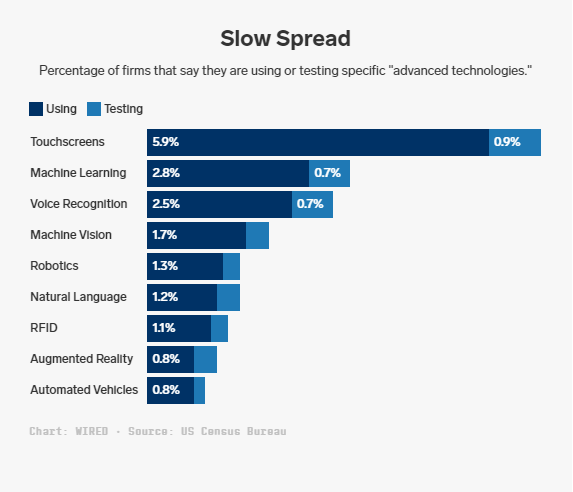
The findings were revealed from the broadest efforts to measure the use of AI. The US Census Bureau surveyed 583,000 US businesses in late 2018 about the usage of AI and other advanced technologies. The results were shown at a virtual conference held by the National Bureau of Economic Research on July 16.


The study found that only 2.8% of businesses had integrated machine learning in their processes, the primary striking technique of modern technologies in AI. Machine-learning algorithms devise their solutions to thorny problems instead of following handwritten instructions. A company might use machine learning to anticipate which products should be sold or the best way to distribute goods from warehouses to customers. The percentage of firms using any forms of AI, including voice recognition, natural language processing, machine vision, or autonomous vehicles — was 8.9 percent. “We are just in the very early days of adopting AI,” says Erik Brynjolfsson, director of the Stanford Digital Economy Lab and a co-author of the Census survey. 


AI was found to be less widespread than some earlier estimates. McKinsey reported in November 2018 that 30% of surveyed firms were piloting some forms of AI. Another study by PwC in 2018, the figure was lower, at 20%. The reason contributing to the discrepancy is that those who responded to the Census survey might not realize that their companies are using some form of AI.


Even if AI hasn’t become popular yet, the fact that it is more widespread at big companies is important, since those companies tend to drive a more significant proportion of the economic activities than their sizes suggest. One example is the rapid increase in the use of AI coming from Google. Their software framework for creating AI programs has been downloaded 100 million times since it was launched five years ago, with 10 million times alone in May 2020.


However, the benefits of using advanced technology may not equally share with all organizations. The technology adoption in large and old companies might lead to increased separation between typical firms and superstar ones. While small businesses often fail behind large ones, there are some excellent adopters who are creative and ambitious enough to become the larger firms in the future.


Source: WIRED


About us: TMA Solutions was established in 1997 to provide quality software outsourcing services to leading companies worldwide. We are one of the largest software outsourcing companies in Vietnam with 2,500 engineers.

Visit us at https://www.tmasolutions.com/

Tags

Recent Post