Latest News

Showing posts with label artificial intelligent. Show all posts

Tuesday, September 1, 2020

Assessing the performance of surgeons by scanning their brain

The researchers have researched and developed a deep learning AI tool called Brain-Net that can rely on surgeons' neuroimaging data to accurately predict their certification scores.

Objective assessments of surgeons' surgical skills are determined through certification scores, known as the Fundamentals of Laparoscopic Surgery program (FLS). The certification score demonstrated effective training is calculated manually using a formula that consumes effort and time. 

Researchers have applied nationally The Fundamental of Laparoscopic Surgery program for medical subjects including surgical residents, fellows, and practicing physicians with the aim of learning and practicing endoscopy, enabling them to measure and document those skills. Besides, the time of the surgical task execution, as well as error estimation, are the scoring platform, which is one of the crucial aspects of this program. 

AI can predict a surgeon’s certification scores based on their neuroimaging data. (Photo: News Punch)

Thanks to a simultaneous neural network from using optical imaging of the human brain, the team of researchers were able to accurately predict the FLS score of surgeons. They used functional near-infrared spectroscopy (fNIRS) data which is effective in categorizing different motor tasks, to predict the final performance score used in the surgical certification. These outcomes are a premise to improve surgical skill acquisition, retention, and the certification process by utilizing neuroimaging and deep learning for neurofeedback. While current approaches only concentrate on task repetition without the potential for fast and objective feedback, these new approaches can enable a more personalized training regimen with bedside responding for optimal skill acquisition.

The neuropsychiatry of surgeons is a way to improve the way their surgical skills are taught and evaluated, thus laying the foundation for new improvements in surgical mission performance and personalized training methods in the future. Moreover, researchers also hope future studies will be able to find a new arrangement of neuro biomarkers that give a better understanding of surgical skill learning and execution.

Source: Digitaltrends

About us: TMA Solutions was established in 1997 to provide quality software outsourcing services to leading companies worldwide. We are one of the largest software outsourcing companies in Vietnam with 2,500 engineers.

Visit us at https://www.tmasolutions.com/


Wednesday, August 26, 2020

Artificial Intelligence turns human thoughts into text applying brain implant

By analyzing human brain activity, an artificial intelligence system can translate a person’s thoughts into real words with an accuracy rate of 97%. From a set of between 30 and 50 sentences, AI is able to decipher up to 250 words in real-time.

The researchers set the algorithm utilizing the neural signals of four women with electrodes implanted in their brains, which were already in place to monitor epileptic seizures. While the people were constantly reading sentences aloud, the researchers provided the brain data to the AI to eliminate patterns that may be related to individual words. The average word error rate per repeating population is as low as 3%.

Speed ​​and accuracy, compared to natural speech, are tough standards for scientists to develop artificial intelligence systems that decode human brain signals. A trained repetitive neural network for the advancement of machine translation can encode each sentence-length sequence of nerve activity into an abstract representation and decode them into complete English sentences.

AI can translate neural activity into sentences with an accuracy rate of 97 percent (Photo: Getty Images)

However, the system is still deficient. In fact, the average working vocabulary of an English speaker is estimated to be around 20,000 words and this is what hinders normal verbal understanding of the system. Each new word increases the number of possible sentences while the AI system improves prediction based on learning the structure of a sentence. As a result, the scaling of the system is hampered and the overall accuracy also decreases.

In order to partially solve this problem, a possibility is presented to integrate the system with other brain-computer interface technologies using different types of algorithms and implants. In 2019, a report by the Royal Society claimed that the neural interfaces connecting computers to human brains would enable mind reading between humans. Besides, within two decades, diseases like Alzheimer's are able to be treated with the use of these interfaces, which will be an “established option”.

In the future, applications for linking the human brain to technology will be upgraded to a variety of ways such as humans can taste and smell with no sensory experience.

Source: Independent

About us: TMA Solutions was established in 1997 to provide quality software outsourcing services to leading companies worldwide. We are one of the largest software outsourcing companies in Vietnam with 2,500 engineers.

Visit us at https://www.tmasolutions.com/


Tuesday, August 18, 2020

5 Steps To Make Chatbots More Intelligent With Contextual Intelligence

Chatbots need to have contextual awareness if they have to sufficiently resolve a query. Conversational UX relies on effective contextual intelligence to handle millions of queries over periods to create more meaningful relationships with customers. 


Designing a Contextual Chatbot

Embedding contextual analysis is an important first step from the beginning. Besides, designing a contextual chatbot requires a strategic plan about key characteristics and use-cases for the technology. 


Planning can be optimized by analyzing existing features & area and mapping out future requirements for specific use cases. Through this process, various technology integrations can be put in place to ensure that there is congruence. 


Added to that, a contextual chatbot requires an integrated approach, massive data lakes and the right analytics methodology to design and development. 


Training With the Right Data Sets

To make chatbots more contextually intelligent, you need to provide the right data sets. It can source the true meaning behind critical keywords to strengthen its neural network. This makes the context richer, especially in the case of customer-oriented chatbots.


The probability model needs the right type of data to adequately perform significant functions. The chatbot needs to understand real conversations to be able to derive real responses to future queries. A high-quality intent classification model needs to be designed keeping focused raw data at the center of the process.

Context Management | kore.ai

Integrating the Right Technologies

Whether that’s open-source technologies or vendor-driven systems, you need to find the right integrated technologies. The contextual chatbot needs complex technology such as Tensorflow or Dialogflow to handle complex queries.


Chatbots must be able to store and retrieve important information related to the context being analyzed. Moreover, you can even timecode the interaction to extract information using for analysis. For example, you can understand the type of action that is being conveyed in a query or a sentence. Then it conveys the right response based on this action-oriented model. 


Applying NLP and Deep Learning

Traditional chatbots rely on a retrieval-based model that works within specified parameters. But the contextual chatbots require a more powerful NLP network and greater access to deep learning resources so that the system can learn key phrases to implement to create new chains of responses.


When chatbots are having thousands of simultaneous conversations, they automatically iterate on the best responses by using NLP. NLP helps to understand new information as it enters the systems and you can test out various responses


Sophisticated data mining tools are also required to ensure that there is a deeper context for every dialogue had. Through greater resource allocation and complex analytical models, the incoming data can be parsed and categorized effectively into segments that are run independently through the network. After that, nodes can act as connectors to ensure that there is a contextual response given to each query.


Differentiating between Sessions Context vs User Context

The chatbot needs to be complex enough to capture bigdata about the conversations as well as the customer’s profile for session context, which helps it to be more contextually intelligent and relevant for customers. 


When moving on from subject to subject, chatbots are contextually aware and create the most suitable responses on the context detected. As a result, this leads to the retention of the customer while engaging them in a more meaningful conversation.


In conclusion, to make chatbots become more intelligent, you need to analyze large data sets through a more complex model in real-time to understand the context. Chatbots also need constant training to enhance the ability to respond appropriately because each industry has unique requirements.


Source: DZone


About us: TMA Solutions was established in 1997 to provide quality software outsourcing services to leading companies worldwide. We are one of the largest software outsourcing companies in Vietnam with 2,500 engineers. Visit us at https://www.tmasolutions.com/


Wednesday, July 29, 2020

ROBOT CLEANERS USED IN LEEDS TRIALS

Robots are being trialled to see how effective they can be in disinfecting items and public areas in the fight against coronavirus.

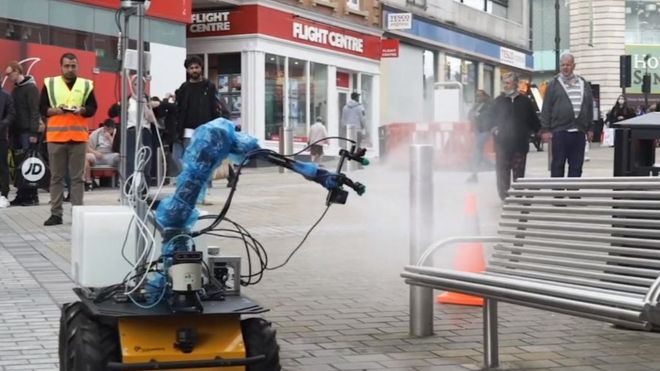
Robot in Leeds city centre

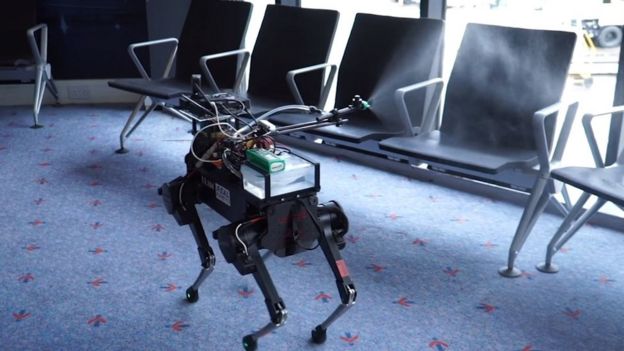
The University of Leeds is using robots to help sanitise parts of the city centre and Leeds Bradford Airport. The schemes aim to reduce the risk of Covid-19 transfer to both cleaning staff and the public.

The robots being used in the city centre and the airport were originally designed to inspect, and conduct repairs on, infrastructure such as pipes and bridges.

They were developed by researchers in the Self Repairing Cities project, a consortium involving the University of Leeds and Birmingham, and University College London.

Adapted to combine navigation, computer vision and artificial intelligence, they find objects which need regular cleaning and then spray a mist of diluted alcohol over them.


Robot at Leeds Bradford Airport

Dr Bilal Kaddouh, assistant professor at the Leeds School of Mechanical Engineering, said the trials had gone well.

"The robots were able to identify the objects that they needed to clean, and they were able to manoeuvre in the public spaces.

"The robotic arms effectively delivered the disinfectant on to the target surfaces."

The next stage will be to have the robots work autonomously, he said.

 Source: BBC

About us: TMA Solutions was established in 1997 to provide quality software outsourcing services to leading companies worldwide. We are one of the largest software outsourcing companies in Vietnam with 2,500 engineers

 Visit us at https://www.tmasolutions.com/


Tuesday, July 21, 2020

WILL AI REPLACE PROGRAMMERS?

Software developers have plenty to keep them awake at night. Their top concern is no longer how to express the latest algorithm in their favorite language (C, C++,Erlang, Java, etc.). Instead, It’s being replaced by artificial intelligence(AI).

Here we take a look at the process for AI writing code and answer the question: willAI replace programmers?

The Future of AI Technology

In a survey conducted by Evans Data Corp, 550 software developers were asked about the most worrying aspects in their career. 29 percent said, “I and my development efforts are replaced by artificial intelligence.”

A team of researchers at the U.S. Department of Energy's Oak Ridge National Laboratory agrees. By 2040, machine learning and natural language processing technologies will be so advanced that they will be capable of writing better software code. And they’ll do it faster than the best human developers. 

Oxford University’s "The Future of Employment" study warns that software engineers may become computerized as machine learning advances. And software design choices will be optimized by algorithms.

Software development, particularly in safety-critical industries, needs to ensure high code quality that delivers on functional requirements.

So, if AI is developing code, the code should be error- and issue-free. This also includes AI in software testing, as it should be able to detect coding errors “with a reliability that humans are unlikely to match.”

Top Programming Languages for AI Engineers in 2020 | by Claire D ...

Is AI Writing Code Possible?

AI can write code.

In 2015, Andrej Karpathy ran a project that used Recurrent Neural Networks to generate code. He took GitHub’s Linux repository (all the source files and headers files), combined it into one giant document (it was more than 400 MB of C code), and trained the RNN with this code.

AI generated code — including functions and function declarations — overnight. It had parameters, variables, loops, and correct indents. Brackets were opened and later closed. It even had comments.

However, the AI produced code had syntactic errors. It didn’t keep track of variable names.  Sometimes variables were declared but never used. Other times variables were used but not defined. The second function in the code example compares "tty == tty".

The project is available on GitHub. It uses the Torch7 deep learning library. Here is the whole output file produced by Karpathy’s exercise.

So, Will AI Replace Programmers?

AI won’t replace programmers. But AI might write code one day.

Of course, it will take time before AI will be able to create actual, production-worthy code that spans more than a few lines.

Advancement in Artificial Intelligence: Human+Machine ...

Here’s how AI will impact software development in the near future.

AI Will Improve

It will become effective at helping developers understand their options. And it will then let the human decide how to optimize for circumstances beyond AI’s understanding.

AI Will Become a Coding Partner

Software developers will use AI as a coding pair to write better software.

But Programmers Will Remain Important

The true value of a programmer is not knowing how to build it. The value is in knowing what to build.

It will take even longer before AI learns how to interpret the business value of each feature and advise you what to develop first. There will always be a role for the human programmer.

What If AI Writes Reliable Code?

That’s a big "if". Most humans can’t write reliable code. And AI is just an application that analyzes vast amounts of human written code. So, it’s unlikely that AI will write reliable code.

So, AI isn’t the answer to improving code quality.

Source: Perforce


 About us: TMA Solutions was established in 1997 to provide quality software outsourcing services to leading companies worldwide. We are one of the largest software outsourcing companies in Vietnam with 2,500 engineers

 Visit us at https://www.tmasolutions.com/

Wednesday, July 15, 2020

Artificial Intelligence makes blurry face 60 times sharper

Researchers have developed an innovative product, AI tool that can turn unrecognizable, blurry facial pictures into convincing computer-generated portraits, in sharper detail than ever before.

In previous times, you can scale an image of a face maximum eight times its original resolution. Traditional approaches take a low-resolution image and 'guess' what extra pixels are needed by trying to get them to match, on average, with corresponding pixels in high-resolution images the computer has seen before. As a result of this averaging, textured areas in hair and skin that might not line up perfectly from one pixel to the next end up looking fuzzy and indistinct.

Seeing this setback, a team of researchers came up with a different approach. Instead of taking a low-resolution image and slowly adding new detail, the system scours AI-generated examples of high-resolution faces, searching for ones that look as much as possible like the input image when shrunk down to the same size. They have found ways to take a handful of pixels and create realistic-looking faces with up to 64 times the resolution, so detailed features such as eyelashes or fine lines. 

The team used a tool in machine learning called a "generative adversarial network," or GAN, which are two neural networks trained on the same data set of photos. One network comes up with AI-created human faces that mimic the ones it was trained on, while the other takes this output and decides if it is convincing enough to be mistaken for the real thing. The first network gets better and better with experience until the second network can't tell the difference. From a single blurred image of a face, it can spit out any number of uncannily lifelike possibilities, each of which looks subtly like a different person.

Artificial Intelligence makes blurry face 60 times sharper - Technology Innovation

Even given pixelated photos where the eyes and mouth are barely recognizable. The system can convert a 16x16-pixel image of a face to 1024 x 1024 pixels in a few seconds, adding more than a million pixels, akin to HD resolution. Details such as pores, wrinkles, and wisps of hair that are imperceptible in the low-res photos become crisp and clear in the computer-generated versions.

However, the system has yet been able to identify people, the researchers stated at this point, it can not turn an out-of-focus, unrecognizable photo from a security camera into a crystal clear image of a real person. It is only capable of creating new faces that do not exist but look highly realistic.

While the researchers focused on faces as a proof of concept, the same technique could, in theory, take low-res shots of almost anything and create sharp, realistic-looking pictures, with applications ranging from medicine and microscopy to astronomy and satellite imagery. This breakthrough acts as a strong foundation for further innovation research in the near foreseeable future, what will the future hold for AI?

Source: Science Daily


About us: TMA Solutions was established in 1997 to provide quality software outsourcing services to leading companies worldwide. We are one of the largest software outsourcing companies in Vietnam with 2,500 engineers.

Visit us at https://www.tmasolutions.com/

Wednesday, May 27, 2020

Vietnam AI Ecosystem


AI is used at Quang Trung Software City in apartment building management. 
VNA/VNS Photo

Following the global trend, the Vietnamese Government aims to turn AI into a driving force of development and make it a top priority in growth policies.
Ministry of Planning and Investment had set up a digital ecosystem for innovation and start-ups. The ministry had proposed to the Prime Minister a national innovation center, which supports technological breakthroughs and creative ideas of Vietnamese entrepreneurs.
The Ministry of Planning and Investment and Ministry of Science and Technology would accompany the AI community to help them address challenges in the process of studying and developing AI in Vietnam.
The Ministry of Planning and Investment had created favorable conditions to attract domestic and international investment in AI. At the Vietnam Venture Summit in June this year, 18 local and foreign investment funds committed investment of US$425 million for Vietnamese start-ups in the next three years.
Putting human resource development at the core of the AI industry, the Vietnamese innovation network had attracted technological experts.
The Ministry planned to expand the network of Vietnamese AI experts in other countries and establish a global fund to train high-quality human resources for the industry.
According to a head of Information Technology Institute of Hanoi University of Science and Technology the Vietnamese AI community is young and has potential to grow quickly. Three years ago, overseas Vietnamese who were experts in the technology sector started to come back to Vietnam to develop AI and help the local community interact more with international counterparts.
The Vietnamese AI community so far involves foreign investors, associations, connecting specialists with State agencies and the market.
An alliance of AI communities in Vietnam debuted last month, including the Digital Transformation community, Machine Learning community, Google Developer community and Business Intelligence community.

Source: Vietnam News (https://vietnamnews.vn/society/534918/viet-nam-puts-priority-on-artificial-intelligence-development.html)

About TMA: TMA Solutions was established in 1997 to provide quality software outsourcing services to leading companies worldwide. We are one of the largest software outsourcing companies in Vietnam with 2,500 engineers.


Monday, May 4, 2020

Vietnam seeks AI training and investment


Hanoi — Vietnam, like many other countries, is in a bid to spur economic innovation with Artificial Intelligence (AI), but experts say the country is starting from at a low point and needs to make a huge effort to catch up with the global trend.
Such efforts would include focusing investment on training skilled workers and building an open-source database.
A researcher from Google DeepMind (USA), said the AI advances of the past decade could create comprehensive changes in global industries and services, from healthcare to energy. He believes the AI laboratories established so far in Vietnam.

Most AI companies in Vietnam are in the first stage of development.
In the past five years, many start-ups have developed projects related to artificial intelligence (AI) and machine learning, and are willing to pay an AI engineer as much as US$1,678 a month, or $22,000 a year. (By an IT recruitment platform report)

Open-source database

Because AI devices learn how humans think and act through the collection of massive data sets, they work best when more data are available.
Vietnam’s weakness is in data and information.
However, experts said they are optimistic about Vietnam’s AI future.
“We have become more serious on this matter; what Vietnam can do now is to strengthen its program data engineering, data mining, and databases,” 
“But most of all, we have to create a community for AI and nurture it,” he said.

According to a survey on 500 Vietnamese firms conducted in 2018 by Vietnam Report, only 13.6 percent have invested in AI in production and business; 18.2 percent are studying the model and 18.2 percent have plans for investment in the coming two to three years. Almost 50 percent of the surveyed companies do not have plans for AI investment yet. 

Source: Vietnam News 

About us: TMA Solutions was established in 1997 to provide quality software outsourcing services to leading companies worldwide. We are one of the largest software outsourcing companies in Vietnam with 2,600 engineers.


Wednesday, March 4, 2020

Last chance to learn how AI impacts the globe – Now or never

Kết quả hình ảnh cho ai impact the world


Have you ever noticed how Artificial Intelligence would change the way the economy functions? If you ever witnessed the recent changes that occurred while running a business or carrying out a mission. If you feel like, you're behind the technology, and you're afraid you could lose your job, then...
Just as the Internet takes over all industries by storm, Artificial Intelligence may have the same effect. AI's desire to take over the work of all is becoming increasingly evident as recent breakthroughs in AI have drawn much public attention. As AI advances, some believe it will take over large sectors of manual workforce increasingly and eventually, according to some research.
But the people who might potentially lose their job are the ones who are unwilling to change. These are the people who are afraid to know and to do something different. Search Results Eric Hoffer once said: "The beginners inherit the earth in times of transition, while the learned are perfectly equipped to deal with an environment that no longer exists."
Looking at AI through the prism of business skills is important to our community, rather than their own insecurities and shortcomings. Note "The glass is half not half empty" AI will narrowly endorse three major impacts:

1.       Affect to Global Economy:
The global economy has been expected to rise to $13 trillion by 2030, and AI is seen by many as an engine of innovation and economic growth. It will increase the efficiency of the tasks carried out and enhance the decision-making process significantly by analyzing tons of data.
Some assume it may increase inequality, push down wages, and reduce the tax base. While these assumptions are real, there is no consensus as to whether the associated risks can materialize, and to what degree.

2.     Effect on humans:
Since the digital revolution, people have been automating almost all the monotonous tasks, which have improved our economy's productivity and innovation.
However, the whole point of the Artificial Intelligence implementation is to function in collective cooperation. People and AI should work hand in hand without delegating 100% of the task to AI. In short, the integration of machines and humans requires a continuous learning process; we can't get benefit from Artificial Intelligence without having to share inputs and information. After that human output will increase exponentially.
But let's take a look at the concept of how artificial intelligence can have an impact on people psychologically:

·       They can understand your feelings:
Human nature is complex, and some of human-led behaviors are often illogical. Some of the day-to-day choices made by humans are influenced by his or her past experience, schooling, thought, and upbringing.
But the findings will always be correct with the convergence of psychology with Artificial Intelligence. Since psychology requires gathering tons and tons of data from different studies on different individuals, communities and populations, which increases the likelihood of drawing the correct conclusion. Yet, if human beings were given the same to process the data, it would inevitably lead to the wrong or biased conclusion. Through the prism of our own understanding, i.e. interpretation, we humans tend to reach conclusions.

·       It can support you in everyday tasks:
Gaining detailed insights has become simple with the advent of Artificial Intelligence. For example, when people are more nervous, information used on StressSense is used to monitor the time and help companies avoid these stressful circumstances. There are many AI-embedded instruments that evaluate physical activity patterns and sleep patterns to help people improve their quality of life.

3.       Impact on the climate:
There are millions of AI impacts on Mother Earth, but the major ones that have the ability to influence supply and demand for resources, there are also some externalities to humans including Paradigm change in how humans consider how our actions affect the climate and how they handle those impacts. With that said, here are the big changers of the game that will improve dramatically:
-          Preventing deforestation
-          Natural resources
-          Sustainable development
-          Agriculture
-          Coastal and Ocean Security
-          Climate forecasts
-          Habitats and wildlife
-          Calamity predictions

Current Impression:
Artificial Intelligence would certainly dramatically change the economy just as the Internet did. But it must be implemented in a way that does not give away all leverage over the activities, such as access to bad information. Mind that this is a program that Man-kind invented but not the other way around. There are both positive and negative impacts at the end of the day; however we should try to eliminate the bad by the good.

About us:

TMA Solutions was established in 1997 to provide quality software outsourcing services to leading companies worldwide. We are one of the largest software outsourcing companies in Vietnam with 2,600 engineers. Our engineering team was selected from a large pool of Vietnam IT resources; they are well-trained and have successfully completed many large and complex projects. Please visit us: https://www.tmasolutions.com/   

Monday, February 24, 2020

Artificial Intelligence (AI) has just discovered a new super antibiotic that can kill the most dangerous antibiotic-resistant bacteria


Kết quả hình ảnh cho antibiotic ai

Researchers have used artificial intelligence to make a major breakthrough in countering the world's most dangerous antibiotic-resistant bacteria. In just a few hours, the algorithm was able to find a new super antibiotic, which could destroy the most dangerous antibiotic-resistant bacteria.

Tests have shown that the new antibiotic can kill antibiotic-resistant bacteria, including Acinetobacter and Enterobacteriaceae. These are two of the three levels of the alert level, which the World Health Organization (WHO) classifies as new antibiotic-resistant bacteria.

This is the first antibiotic found in history. Researcher Regina Barzilay at MIT said: "I think this is the strongest antibiotic that has been made to date. It can kill some dangerous antibiotic resistant bacteria”.

In order to find a new antibiotic, first of all, researchers have to teach a Google’s deep learning algorithm to determine which types of molecules can kill bacteria. To do this, they must provide information on the atomic and molecular features of nearly 2,500 drugs and natural compounds for AI to study.

After entering enough data, AI researchers started working to find new antibiotics. However, instead of focusing on finding an effective antibiotic, the algorithm will focus on finding an unprecedented one. That is the key to destroy the current antibiotic-resistant bacteria.

To expand and search for more new powerful antibiotics, researchers turned to a huge database of about 1.5 billion compounds. They put the algorithm to work with about 107 million of them. After 3 days, AI released a list of 23 new potential antibiotics.

The head of the research project, Dr. Jonathan Stokes, said it was impossible to screen all 107 million compounds manually. Artificial intelligence has helped accomplish this utopia, and shortened the time to just a few days.

Antibiotic-resistance is a concern, because without new antibiotics, 10 million people around the world could be at risk of infection each year. But with artificial intelligence, this worry would be solved soon.


About us:
TMA Solutions was established in 1997 to provide quality software outsourcing services to leading companies worldwide. We are one of the largest software outsourcing companies in Vietnam with 2,600 engineers. Our engineering team was selected from a large pool of Vietnam IT resources; they are well-trained and have successfully completed many large and complex projects. Please visit us: https://www.tmasolutions.com/   

Sunday, February 23, 2020

AI and Machine Learning: Why should be Python?

Kết quả hình ảnh cho python ai

Over the past few years, Python has been celebrated as a relentless climb to distinction and is actually rivaling the situation of one of the planet's most well-known programming dialects.

            And as it rightly says, "If you're famous, there's more to learn than just the stuff themselves!"
            Backed up for applications ranging from cloud advancement to scripting and process mechanization, Python is increasingly becoming the top decision for human-made intelligence or (AI), ML, and deep learning projects among engineers.
Computer-based intelligence or Artificial Intelligence has made application engineers a universe of opportunity. Computer-based information allows Spotify to prescribe to customers’ artisans and melodies, or Netflix to understand what shows you need to see immediately. It is also commonly used by client assistance organizations to drive self-administration and enhance work processes as well as worker productivity.
Simulated or Machine-driven intelligence undertakings contrast with conventional programming undertakings. The distinctions lie in the innovation stack, the skills needed for an AI-based experiment, and the need for in-depth research. To execute your AI wishes, you should use a programming language that is steady, adaptable and has tools that are accessible. Python is offering all of this, which is why we see the Python AI bunches extending today.
Python assists engineers to be competitive and confident about the product they are creating, from development to arrangement and upkeep.
Advantages that make Python the best fit for AI and AI-based undertakings include effortless and reliable access to extraordinary libraries and frameworks for AI and AI (ML) are adaptability, stage freedom, and an extensive network, contributing to the language's general popularity.

Why can everyone easily count on Python's efficiency to make things happen?
-                    An incredible library environment:
            One of the main reasons why Python is the most common programming language used for AI is an exceptional variety of libraries. A library is a module or a set of modules distributed by different sources such as PyPi that integrates a pre-composed bit of code that enables clients to get to some usefulness or perform different activities. Python libraries give things at the base level, so programmers do not necessarily need to code them from the earliest starting point.
-                  
           Primary and inevitable:
           Python offers a short and decipherable code. While complex calculations and flexible work processes remain behind AI and AI, the effortlessness of Python allows engineers to build robust frameworks. Designers find a workable pace in their efforts to address the ML issue, rather than focusing on the specialized subtleties of the language.
             In fact, Python attracts a variety of programmers because it's anything but difficult to learn. Python code is realistic for humans, makes it easier to create AI models.
             Numerous software engineers argue that Python is more intuitive than other programming dialects. Others put together multiple systems, libraries, and upgrades that boost the execution of different functionalities. It is commonly acknowledged that Python is appropriate for shared performance when numerous engineers are involved. Because Python is a commonly used language, it can do a lot of complex AI tasks and enable you to create models quickly that allow you to test your item for AI purposes.
-                  
          The limitation below:
           Working in the ML and AI fields means managing a lot of information that you need to process most advantageously and convincingly. The low section hindrance helps more knowledge researchers to quickly get Python and start using it for AI advancement without squandering an over-exercise in language learning.
             After the regular English language, Python programming language takes place, making the road to learning simpler. Its straightforward punctuation allows you to work with complex frameworks quickly, ensuring clear relationships between the components of the Framework.
-                  
            Wide library and system options:
             It can be doubtful to upgrade AI and ML calculations, and also requires a lot of time. Having a well-organized and well-tried environment is critical to encouraging designers to think about the best coding arrangements.
               Software engineers go to various Python frameworks and libraries to reduce the time needed for development. A software library is a pre-composed code which is used by programmers to recognize common programming errors. With its rich software stack, Python has a broad array of computerized logic and AI libraries.
-                  
              In summary:
              Computer-based intelligence or artificial intelligence profoundly affects the world we live in, with new applications steadily increasing. Brilliant designers choose Python as their favorite programming language for the numerous benefits that make it particularly suitable for AI and deep learning projects.
                 Python's wide selection of AI specific libraries and systems disassemble the process of development and cut time for advancement. The basic grammar and comprehensibility of Python is advancing fast testing of complex calculations and rendering the language available to non-developers.
It also reduces the psychological overhead on engineers, opening up their mental assets with the goal of focusing on critical thinking and achieving venture goals. Ultimately, the simple punctuation makes it easier for designers to work together, or switch transitions between them.
Furthermore, Python flaunts a large, diverse network of designers who are prepared to offer help and support, which can be critical when handling these complex projects.
While other programming dialects can also be used in AI projects, there's no escape from the way Python is at the forefront and critical thinking should be provided. That's why you should consider Python for your AI plan.

About us:
TMA Solutions was established in 1997 to provide quality software outsourcing services to leading companies worldwide. We are one of the largest software outsourcing companies in Vietnam with 2,600 engineers. Our engineering team was selected from a large pool of Vietnam IT resources; they are well-trained and have successfully completed many large and complex projects. Please visit us: https://www.tmasolutions.com/   

Tags

Recent Post