Latest News

Showing posts with label ai/ml. Show all posts

Wednesday, August 12, 2020

Conversational AI Helps Companies To Stay Competitive In Covid-19 Pandemic

Conversational AI is the key component for enterprises to grow sustainably and stay competitive for greater efficiencies.


The pandemic dramatically affects the enterprise’s operations, especially since many contact centers have to close because they cannot cope with the customers’ demand significantly increasing while social distance and the decrease in the workforce.


As a direct result of Covid-19 pandemic, many companies accelerate their digital transformation and automation strategies not only to operate more efficiently but also to avoid disruptions. Because of the flexibility and scalability, a lot of the latest technologies are applied in business activities, especially conversational AI. 

Understanding Conversational AI: As Chat Enabled Customer Service | Hacker  Noon

Conversational AI is speech-based assistants and chatbots to automate communication and create personalized customer experiences via applications, websites or tech devices. It offers humanlike interactions by recognizing voice, text, touch or gesture input with different languages.


A research firm said that "Conversational AI technology is reshaping the customer experience in two ways. First, some customer touchpoints are taken over by the CAIP (Conversational AI platform), freeing up human agents to engage in more value-adding activities that improve the customer outcome. Second, the move to a CAIP actually drives improvement in the customer experience”.


Conversational AI helps companies to avoid the risk of bottlenecks, automatically resolve even the complex problems happening in the customer service process. The capable of seamless integration into backend systems to deliver fast, rich and meaningful customer experience through preferred language. 


The main driving force for AI-powered devices in response to the Covid-19 pandemic is to reduce chatbot development cost, deploy 24/7 omni-channel and enhance customer service support. 


Lastly, it cannot be denied that the Covid-19 pandemic has totally changed the operation of work and social life. But more than anything, the epidemic has promoted the digital process in businesses, and Conversational AI is the key component for enterprises to grow sustainably and stay competitive for greater efficiencies.


Source: DZone

About us: TMA Solutions was established in 1997 to provide quality software outsourcing services to leading companies worldwide. We are one of the largest software outsourcing companies in Vietnam with 2,500 engineers.

Tuesday, August 11, 2020

Machine Learning Is Fun! (Part 3)

Mind Blowage Time

That’s pretty simple, right? Well think about what you just did. You took some data, you fed it through three generic, really simple steps, and you ended up with a function that can guess the price of any house in your area. Watch out, Zillow!


But here’s a few more facts that will blow your mind:

1. Research in many fields (like linguistics/translation) over the last 40 years has shown that these generic learning algorithms that “stir the number stew” (a phrase I just made up) out-perform approaches where real people try to come up with explicit rules themselves. The “dumb” approach of machine learning eventually beats human experts.

2. The function you ended up with is totally dumb. It doesn’t even know what “square feet” or “bedrooms” are. All it knows is that it needs to stir in some amount of those numbers to get the correct answer.

3. It’s very likely you’ll have no idea why a particular set of weights will work. So you’ve just written a function that you don’t really understand but that you can prove will work.

4. Imagine that instead of taking in parameters like “sqft” and “num_of_bedrooms”, your prediction function took in an array of numbers. Let’s say each number represented the brightness of one pixel in an image captured by camera mounted on top of your car. Now let’s say that instead of outputting a prediction called “price”, the function outputted a prediction called “degrees_to_turn_steering_wheel”. You’ve just made a function that can steer your car by itself!

Pretty crazy, right?

What about that whole “try every number” bit in Step 3?

Ok, of course you can’t just try every combination of all possible weights to find the combo that works the best. That would literally take forever since you’d never run out of numbers to try. To avoid that, mathematicians have figured out lots of clever ways to quickly find good values for those weights without having to try very many. Here’s one way:


First, write a simple equation that represents Step #2 above:

This is your cost function.

Now let’s re-write exactly the same equation, but using a bunch of machine learning math jargon (that you can ignore for now):

θ is what represents your current weights. J(θ) means the ‘cost for your current weights’.

This equation represents how wrong our price estimating function is for the weights we currently have set.


If we graph this cost equation for all possible values of our weights for number_of_bedrooms and sqft, we’d get a graph that might look something like this:


The graph of our cost function looks like a bowl. The vertical axis represents the cost.

In this graph, the lowest point in blue is where our cost is the lowest — thus our function is the least wrong. The highest points are where we are most wrong. So if we can find the weights that get us to the lowest point on this graph, we’ll have our answer!


So we just need to adjust our weights so we are “walking downhill” on this graph towards the lowest point. If we keep making small adjustments to our weights that are always moving towards the lowest point, we’ll eventually get there without having to try too many different weights.


If you remember anything from Calculus, you might remember that if you take the derivative of a function, it tells you the slope of the function’s tangent at any point. In other words, it tells us which way is downhill for any given point on our graph. We can use that knowledge to walk downhill.


So if we calculate a partial derivative of our cost function with respect to each of our weights, then we can subtract that value from each weight. That will walk us one step closer to the bottom of the hill. Keep doing that and eventually we’ll reach the bottom of the hill and have the best possible values for our weights. (If that didn’t make sense, don’t worry and keep reading).


That’s a high-level summary of one way to find the best weights for your function called batch gradient descent. Don’t be afraid to dig deeper if you are interested on learning the details.


When you use a machine learning library to solve a real problem, all of this will be done for you. But it’s still useful to have a good idea of what is happening.

What else did you conveniently skip over?

The three-step algorithm I described is called multivariate linear regression. You are estimating the equation for a line that fits through all of your house data points. Then you are using that equation to guess the sales price of houses you’ve never seen before based where that house would appear on your line. It’s a really powerful idea and you can solve “real” problems with it.


But while the approach I showed you might work in simple cases, it won’t work in all cases. One reason is because house prices aren’t always simple enough to follow a continuous line.


But luckily there are lots of ways to handle that. There are plenty of other machine learning algorithms that can handle non-linear data (like neural networks or SVMs with kernels). There are also ways to use linear regression more cleverly that allow for more complicated lines to be fit. In all cases, the same basic idea of needing to find the best weights still applies.


Also, I ignored the idea of overfitting. It’s easy to come up with a set of weights that always works perfectly for predicting the prices of the houses in your original data set but never actually works for any new houses that weren’t in your original data set. But there are ways to deal with this (like regularization and using a cross-validation data set). Learning how to deal with this issue is a key part of learning how to apply machine learning successfully.


In other words, while the basic concept is pretty simple, it takes some skill and experience to apply machine learning and get useful results. But it’s a skill that any developer can learn!

Is machine learning magic?

Once you start seeing how easily machine learning techniques can be applied to problems that seem really hard (like handwriting recognition), you start to get the feeling that you could use machine learning to solve any problem and get an answer as long as you have enough data. Just feed in the data and watch the computer magically figure out the equation that fits the data!


But it’s important to remember that machine learning only works if the problem is actually solvable with the data that you have.


For example, if you build a model that predicts home prices based on the type of potted plants in each house, it’s never going to work. There just isn’t any kind of relationship between the potted plants in each house and the home’s sale price. So no matter how hard it tries, the computer can never deduce a relationship between the two.

You can only model relationships that actually exist.

So remember, if a human expert couldn’t use the data to solve the problem manually, a computer probably won’t be able to either. Instead, focus on problems where a human could solve the problem, but where it would be great if a computer could solve it much more quickly.

How to learn more about Machine Learning?

In my mind, the biggest problem with machine learning right now is that it mostly lives in the world of academia and commercial research groups. There isn’t a lot of easy to understand material out there for people who would like to get a broad understanding without actually becoming experts. But it’s getting a little better every day.


If you want to try out what you’ve learned in this article, I made a course that walks you through every step of this article, including writing all the code. Give it a try!


If you want to go deeper, Andrew Ng’s free Machine Learning class on Coursera is pretty amazing as a next step. I highly recommend it. It should be accessible to anyone who has a Comp. Sci. degree and who remembers a very minimal amount of math.


Also, you can play around with tons of machine learning algorithms by downloading and installing SciKit-Learn. It’s a python framework that has “black box” versions of all the standard algorithms.


Source: Medium.com


About us: TMA Solutions was established in 1997 to provide quality software outsourcing services to leading companies worldwide. We are one of the largest software outsourcing companies in Vietnam with 2,500 engineers.

Visit us at https://www.tmasolutions.com/

Thursday, July 30, 2020

Recognizing deep-fake images using frequency analysis

They look convincingly real, and it is very challenging to distinguish them from real photos. However, researchers have found a new way to identify them.

These images (called deep-fake images) are created by machine learning algorithms and it is very challenging to distinguish them from real photos. Researchers have found a new method to effectively identify those images. They analyze the objects in the frequency domain and set up a signal processing technique.

Interaction of two algorithms results in new images
Deep-fake images - are generated with the help of computer models, so-called Generative Adversarial Networks, GANs for short. Two algorithms work together in these networks: the first algorithm creates random images based on certain input data. The second algorithm needs to decide whether the image is a fake or not. If the image is found to be a fake, the second algorithm gives the first algorithm the command to revise the image - until it no longer recognizes it as a fake.
Frequency analysis reveals typical artefacts in computer-generated images. Credit: © RUB, Marquard

Frequency analysis reveals typical artefacts
Nowadays, deep-fake images have been analysed using complex statistical methods. The research group chose a different approach by converting the images into the frequency domain using the discrete cosine transform. The generated image is then expressed as the sum of many different cosine functions. Natural images consist mainly of low-frequency functions.

The analysis has shown that images generated by GANs exhibit artefacts in the high-frequency range. For example, a typical grid structure emerges in the frequency representation of fake images. "Our experiments showed that these artefacts do not only occur in GAN generated images. They are a structural problem of all deep learning algorithms," explains Joel Frank from the Chair for Systems Security. "We assume that the artefacts described in our study will always tell us whether the image is a deep-fake image created by machine learning," adds Frank. "Frequency analysis is therefore an effective way to automatically recognise computer-generated images."

Source: Science Daily


About us: TMA Solutions was established in 1997 to provide quality software outsourcing services to leading companies worldwide. We are one of the largest software outsourcing companies in Vietnam with 2,500 engineers. 

Wednesday, July 29, 2020

ROBOT CLEANERS USED IN LEEDS TRIALS

Robots are being trialled to see how effective they can be in disinfecting items and public areas in the fight against coronavirus.

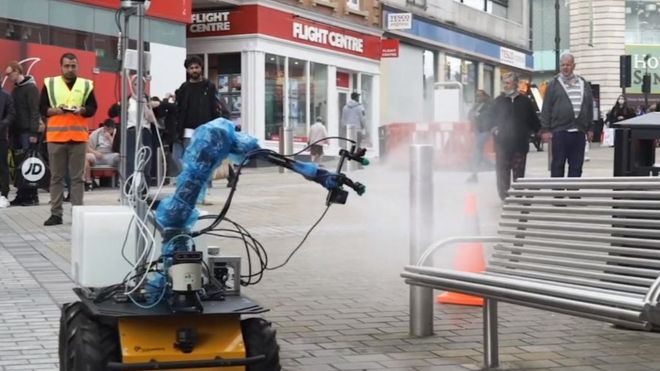
Robot in Leeds city centre

The University of Leeds is using robots to help sanitise parts of the city centre and Leeds Bradford Airport. The schemes aim to reduce the risk of Covid-19 transfer to both cleaning staff and the public.

The robots being used in the city centre and the airport were originally designed to inspect, and conduct repairs on, infrastructure such as pipes and bridges.

They were developed by researchers in the Self Repairing Cities project, a consortium involving the University of Leeds and Birmingham, and University College London.

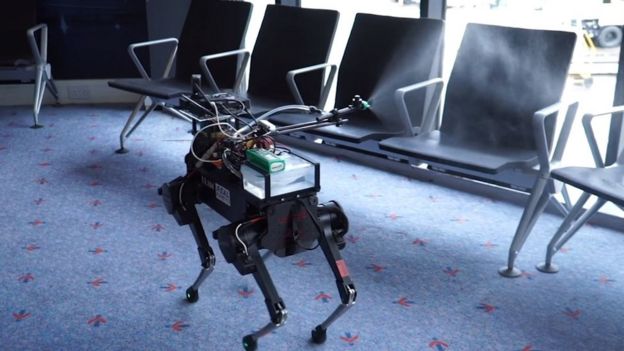
Adapted to combine navigation, computer vision and artificial intelligence, they find objects which need regular cleaning and then spray a mist of diluted alcohol over them.


Robot at Leeds Bradford Airport

Dr Bilal Kaddouh, assistant professor at the Leeds School of Mechanical Engineering, said the trials had gone well.

"The robots were able to identify the objects that they needed to clean, and they were able to manoeuvre in the public spaces.

"The robotic arms effectively delivered the disinfectant on to the target surfaces."

The next stage will be to have the robots work autonomously, he said.

 Source: BBC

About us: TMA Solutions was established in 1997 to provide quality software outsourcing services to leading companies worldwide. We are one of the largest software outsourcing companies in Vietnam with 2,500 engineers

 Visit us at https://www.tmasolutions.com/


Tuesday, July 28, 2020

3 Use Cases Of Artificial Intelligence In Business

With the rapid development of 4.0 Industrial Revolution, Artificial Intelligence was gradually applied in many fields from manufacturing, services, transportation to health and education. According to the study by Harvard Business Review, there are three main purposes for enterprises to apply AI: Robotic Process Automation, Cognitive Engagement and Cognitive Insight. 


Robotic Process Automation (RPA) is the most common need when businesses use AI with low investment costs and ease of implementation. These applications can automatically update the customer information and profiles, communicate with customers through a chatbot and provide basic guidance on standardized information and documents. Those help businesses in management and customer care.  


Cognitive Insight uses more complex algorithms incorporating machine learning to identify patterns from multiple data sets and extract meaning from them. The applications of Cognitive Insight are used in activities such as making prediction about purchasing options, detecting fraudulent transactions, automating advertisements in the direction of personalization, etc. Deep insights are accessed from user data, predicting customer behavior, and providing solutions with constantly updated and improved data. The goal is to improve the performance of tasks performed by machines that require a fast level of automation and massive data, beyond human capabilities.


Cognitive Engagement is a way of approaching customers by predicting analytics to provide insight into future customer behavior. Artificial Intelligence helps to provide maximum personalized content in interacting with customers quickly, right content, right audience and right time. As a result, businesses can formulate strategies and plans to increase interaction efficiency with customers and increase competitive advantage.


Depending on the specific needs and purposes, businesses can apply individually or combine the above applications for business activities in the most effective way.


Source: Toptal


About us: TMA Solutions was established in 1997 to provide quality software outsourcing services to leading companies worldwide. We are one of the largest software outsourcing companies in Vietnam with 2,500 engineers

Visit us at https://www.tmasolutions.com/


Tuesday, July 21, 2020

WILL AI REPLACE PROGRAMMERS?

Software developers have plenty to keep them awake at night. Their top concern is no longer how to express the latest algorithm in their favorite language (C, C++,Erlang, Java, etc.). Instead, It’s being replaced by artificial intelligence(AI).

Here we take a look at the process for AI writing code and answer the question: willAI replace programmers?

The Future of AI Technology

In a survey conducted by Evans Data Corp, 550 software developers were asked about the most worrying aspects in their career. 29 percent said, “I and my development efforts are replaced by artificial intelligence.”

A team of researchers at the U.S. Department of Energy's Oak Ridge National Laboratory agrees. By 2040, machine learning and natural language processing technologies will be so advanced that they will be capable of writing better software code. And they’ll do it faster than the best human developers. 

Oxford University’s "The Future of Employment" study warns that software engineers may become computerized as machine learning advances. And software design choices will be optimized by algorithms.

Software development, particularly in safety-critical industries, needs to ensure high code quality that delivers on functional requirements.

So, if AI is developing code, the code should be error- and issue-free. This also includes AI in software testing, as it should be able to detect coding errors “with a reliability that humans are unlikely to match.”

Top Programming Languages for AI Engineers in 2020 | by Claire D ...

Is AI Writing Code Possible?

AI can write code.

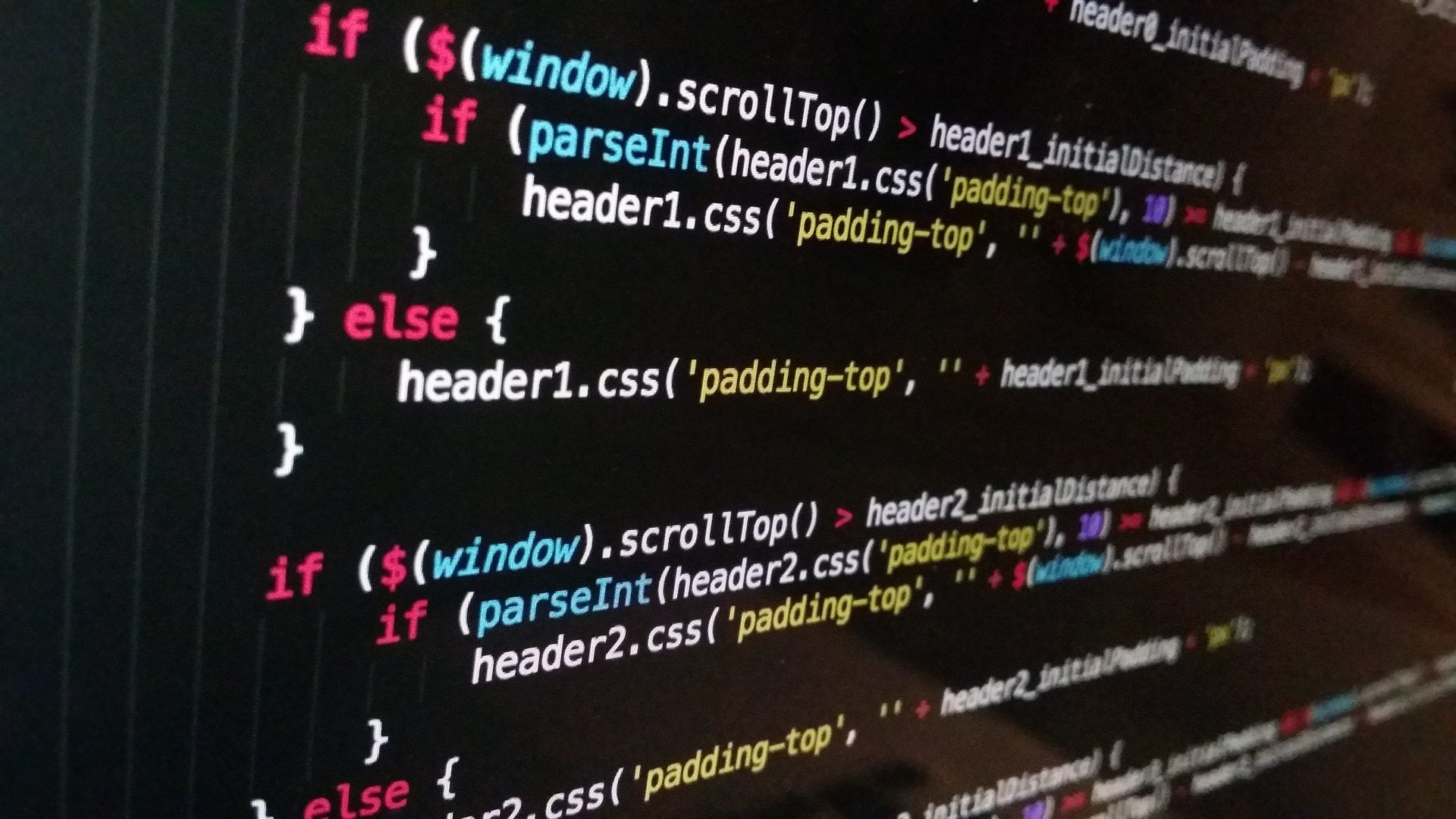
In 2015, Andrej Karpathy ran a project that used Recurrent Neural Networks to generate code. He took GitHub’s Linux repository (all the source files and headers files), combined it into one giant document (it was more than 400 MB of C code), and trained the RNN with this code.

AI generated code — including functions and function declarations — overnight. It had parameters, variables, loops, and correct indents. Brackets were opened and later closed. It even had comments.

However, the AI produced code had syntactic errors. It didn’t keep track of variable names.  Sometimes variables were declared but never used. Other times variables were used but not defined. The second function in the code example compares "tty == tty".

The project is available on GitHub. It uses the Torch7 deep learning library. Here is the whole output file produced by Karpathy’s exercise.

So, Will AI Replace Programmers?

AI won’t replace programmers. But AI might write code one day.

Of course, it will take time before AI will be able to create actual, production-worthy code that spans more than a few lines.

Advancement in Artificial Intelligence: Human+Machine ...

Here’s how AI will impact software development in the near future.

AI Will Improve

It will become effective at helping developers understand their options. And it will then let the human decide how to optimize for circumstances beyond AI’s understanding.

AI Will Become a Coding Partner

Software developers will use AI as a coding pair to write better software.

But Programmers Will Remain Important

The true value of a programmer is not knowing how to build it. The value is in knowing what to build.

It will take even longer before AI learns how to interpret the business value of each feature and advise you what to develop first. There will always be a role for the human programmer.

What If AI Writes Reliable Code?

That’s a big "if". Most humans can’t write reliable code. And AI is just an application that analyzes vast amounts of human written code. So, it’s unlikely that AI will write reliable code.

So, AI isn’t the answer to improving code quality.

Source: Perforce


 About us: TMA Solutions was established in 1997 to provide quality software outsourcing services to leading companies worldwide. We are one of the largest software outsourcing companies in Vietnam with 2,500 engineers

 Visit us at https://www.tmasolutions.com/

Sunday, July 19, 2020

Artificial Intelligence Chatbots - The future of customer services

A chatbot is artificial intelligence (AI) software application that can simulate a conversation with a user instead of real human in natural language through online messaging applications, websites, mobile apps or through the telephone. 


The purpose of chatbot technology is not to eliminate people, it was born to integrate the power of humans, machines and AI to bring the best satisfaction to customers. In recent years, chatbots are widely used in many fields, especially in services. It can be easily integrated into popular communication platforms such as Facebook, Instagram,... which helps businesses to increase their appearance on customer journey. Below is 4 main benefits that Chatbot can bring to your business: 


  1. Improve customer experience: With a real-time appearance and 24/7 support, chatbots can reduce waiting time, provide rich content to automatically resolve common queries and give a positive impact on customers to enhance customer experience.

  2. Personalize communication channel: Besides being the easier and faster ways to interact, customers like products that are right for them and solutions that solve the problems they encounter, so personalization is an especially important aspect of customer services. Personalization makes customers feel concerned and respected by the business. 

  3. Reduce cost: About 80% of customer inquiries, questions asked the same problem. Therefore, the cost of building a chatbot is cheaper than hiring a large number of employees. The businesses can make significant savings from recruitment, training and payroll costs. 

  4. Understand customer insights: Chatbot is not only a communication channel but also a medium to collect information, gather behaviors and preferences to dig customer insights. Leverage big data from many sources, businesses can analyze data and develop appropriate plans and strategies to approach more and more customers. 


Chatbot is the opportunity, the future and the key to connecting your business to new customer generation. Take advantage and become a successful business!


Source: D Zone

About us: TMA Solutions was established in 1997 to provide quality software outsourcing services to leading companies worldwide. We are one of the largest software outsourcing companies in Vietnam with 2,500 engineers Visit us at https://www.tmasolutions.com/

Wednesday, July 15, 2020

Artificial Intelligence makes blurry face 60 times sharper

Researchers have developed an innovative product, AI tool that can turn unrecognizable, blurry facial pictures into convincing computer-generated portraits, in sharper detail than ever before.

In previous times, you can scale an image of a face maximum eight times its original resolution. Traditional approaches take a low-resolution image and 'guess' what extra pixels are needed by trying to get them to match, on average, with corresponding pixels in high-resolution images the computer has seen before. As a result of this averaging, textured areas in hair and skin that might not line up perfectly from one pixel to the next end up looking fuzzy and indistinct.

Seeing this setback, a team of researchers came up with a different approach. Instead of taking a low-resolution image and slowly adding new detail, the system scours AI-generated examples of high-resolution faces, searching for ones that look as much as possible like the input image when shrunk down to the same size. They have found ways to take a handful of pixels and create realistic-looking faces with up to 64 times the resolution, so detailed features such as eyelashes or fine lines. 

The team used a tool in machine learning called a "generative adversarial network," or GAN, which are two neural networks trained on the same data set of photos. One network comes up with AI-created human faces that mimic the ones it was trained on, while the other takes this output and decides if it is convincing enough to be mistaken for the real thing. The first network gets better and better with experience until the second network can't tell the difference. From a single blurred image of a face, it can spit out any number of uncannily lifelike possibilities, each of which looks subtly like a different person.

Artificial Intelligence makes blurry face 60 times sharper - Technology Innovation

Even given pixelated photos where the eyes and mouth are barely recognizable. The system can convert a 16x16-pixel image of a face to 1024 x 1024 pixels in a few seconds, adding more than a million pixels, akin to HD resolution. Details such as pores, wrinkles, and wisps of hair that are imperceptible in the low-res photos become crisp and clear in the computer-generated versions.

However, the system has yet been able to identify people, the researchers stated at this point, it can not turn an out-of-focus, unrecognizable photo from a security camera into a crystal clear image of a real person. It is only capable of creating new faces that do not exist but look highly realistic.

While the researchers focused on faces as a proof of concept, the same technique could, in theory, take low-res shots of almost anything and create sharp, realistic-looking pictures, with applications ranging from medicine and microscopy to astronomy and satellite imagery. This breakthrough acts as a strong foundation for further innovation research in the near foreseeable future, what will the future hold for AI?

Source: Science Daily


About us: TMA Solutions was established in 1997 to provide quality software outsourcing services to leading companies worldwide. We are one of the largest software outsourcing companies in Vietnam with 2,500 engineers.

Visit us at https://www.tmasolutions.com/

Thursday, July 9, 2020

AI Helps To Differentiate Between Original Images And Reflections

Nowadays, a lot of tools are used to change and reflect images that many people can not recognize the difference on the other side of the mirror. But Artificial Intelligence can pick up many clues that are difficult for people to notice. AI can differentiate between original images and reflections easily with 60% to 90% accuracy, depending on the kinds of images used to train the algorithm. 


To discover how AI works, the researchers developed heat map technology to indicate the parts of the images that interest the algorithm. The study showed that AI focusing on wristwatches, shirt collars (buttons tend to be on the left side), faces and phones - which most people tend to carry in their right hand. Then they did another study focusing on faces and found that the heat map lit up on areas such as the hair part, eye gaze and beards. Although the researchers don’t understand what information can be found in beards, they hypothesized that the way people comb or shave their faces could reveal handedness.


This study helps to examine how reflected images different from the originals and reveal information about prejudice in machine learning that might lead to inaccurate results. Furthermore, the findings with implications help to train machine learning models and detect faked images.


Source: Science Daily

About us: TMA Solutions was established in 1997 to provide quality software outsourcing services to leading companies worldwide. We are one of the largest software outsourcing companies in Vietnam with 2,500 engineers

Visit us at https://www.tmasolutions.com/


How Does Artificial Intelligence Applied In Healthcare?

How Does Artificial Intelligence Applied In Healthcare?

Artificial Intelligence has already been implemented in the healthcare sector. Now the use of computer vision in this field is making surface and can support the rise to various applications that can prove to be life-saving for patients.

This AI-powered technology is assisting more doctors to better diagnose their patients, prescribe the right treatments and monitor the evolution of several diseases. Currently, there are several areas in healthcare where computer vision is being utilized and benefiting medical professionals to better diagnose patients, including medical imaging analysis, predictive analysis, health monitoring, among others. Below the benefits computer vision technology can assist health systems.

 Precise Diagnoses  

Attacking Cancer Cells Where They Hide | CTCA

Computer vision systems offer precise diagnoses minimizing false positives. The technology can potentially obliterate the requirement for redundant surgical procedures and expensive therapies. Computer vision algorithms trained using a huge amount of training data can detect the slightest presence of a condition which may typically be missed out by human doctors because of their sensory limitations. The use of computer vision in healthcare diagnosis can provide significantly high levels of precision which may in coming days go up to 100 percent.

 Timely Detection of Illness  

How daylight saving time stumps hospital record keeping ...

There are most fatal illnesses that need to be diagnosed in their early stages, such as cancer. Computer vision enables the detection of early symptoms with high certainty owing to its finely tuned pattern-recognition capability. This can be useful in timely treatment and saving countless lives for the long term.

 Heightened Medical Process 

Talking with Dental Patients About Insurance - Spear Education

The use of computer vision in healthcare can considerably lessen the time doctors usually take in analysing reports and images. It frees and offers them more time to spend with patients and provide personalized and constructive advice. By enhancing the quality of physician-patient interactions, it can also assist medical professionals to give consultation to more and more patients.

The use of computer vision in healthcare supports caregivers to deliver efficient and accurate healthcare services through its life-saving applications.

 Medical Imaging

PACS — Insignia Medical Systems

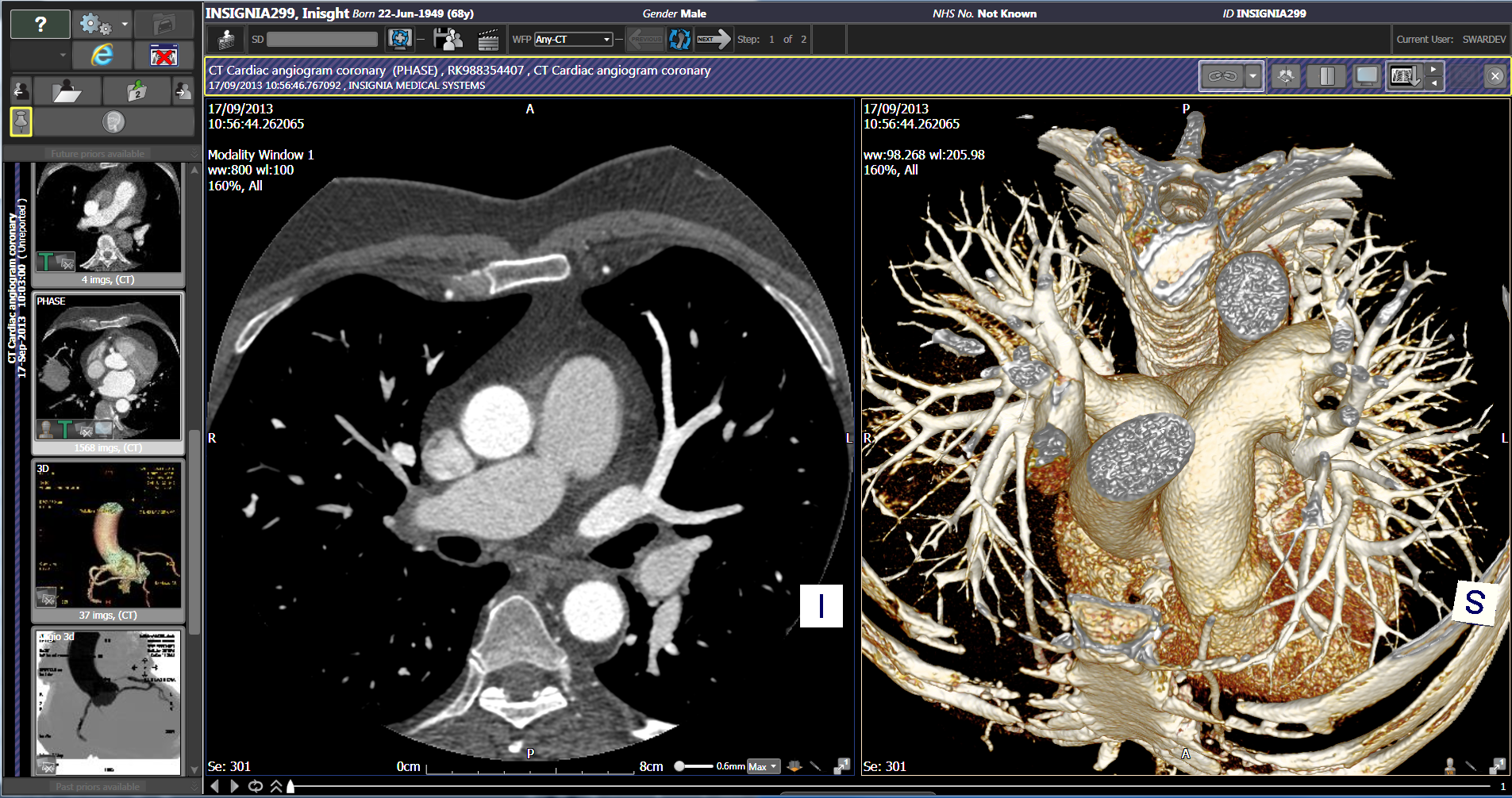
For the last decades, computer-supported medical imaging application has been a trustworthy help for physicians. It doesn’t only create and analyse images, but also becomes an assistant and helps doctors with their interpretation. The application is used to read and convert 2D scan images into interactive 3D models that enable medical professionals to gain a detailed understanding of a patient’s health condition.

 Computer Vision for Health Monitoring

GE Health Stations and Servers Vulnerable to Cyberattack, FDA ...

By leveraging computer vision technology doctors can analyse health and fitness metrics to assist patients to make faster and better medical decisions. Today, it is being utilized by healthcare centers to measure the blood lost during surgeries. This can assist in taking emergency measures if the quantity of blood lost reaches the last stage. Additionally, the technology can also be leveraged to measure the body fat percentage of people using images taken from regular cameras.

 Nuclear Medicine

As a section of clinical medicine, nuclear medicine deals with the use of radionuclide pharmaceuticals in diagnosis. Sometimes computer vision techniques of remote radiation therapy are also referred to nuclear medicine. In diagnostics, it mainly utilizes single-photon emission computed tomography and positron emission tomography.

Computer vision not only helps medical professionals in saving their valuable time on basic tasks but also saving patients’ life. The applications of the technology for medical use has to perform by extending current ways that it’s already being used and adding a layer of creativity and imagination.

Source: analyticsinsight


 About us: TMA Solutions was established in 1997 to provide quality software outsourcing services to leading companies worldwide. We are one of the largest software outsourcing companies in Vietnam with 2,500 engineers

 Visit us at https://www.tmasolutions.com/


Wednesday, May 27, 2020

Vietnam AI Ecosystem


AI is used at Quang Trung Software City in apartment building management. 
VNA/VNS Photo

Following the global trend, the Vietnamese Government aims to turn AI into a driving force of development and make it a top priority in growth policies.
Ministry of Planning and Investment had set up a digital ecosystem for innovation and start-ups. The ministry had proposed to the Prime Minister a national innovation center, which supports technological breakthroughs and creative ideas of Vietnamese entrepreneurs.
The Ministry of Planning and Investment and Ministry of Science and Technology would accompany the AI community to help them address challenges in the process of studying and developing AI in Vietnam.
The Ministry of Planning and Investment had created favorable conditions to attract domestic and international investment in AI. At the Vietnam Venture Summit in June this year, 18 local and foreign investment funds committed investment of US$425 million for Vietnamese start-ups in the next three years.
Putting human resource development at the core of the AI industry, the Vietnamese innovation network had attracted technological experts.
The Ministry planned to expand the network of Vietnamese AI experts in other countries and establish a global fund to train high-quality human resources for the industry.
According to a head of Information Technology Institute of Hanoi University of Science and Technology the Vietnamese AI community is young and has potential to grow quickly. Three years ago, overseas Vietnamese who were experts in the technology sector started to come back to Vietnam to develop AI and help the local community interact more with international counterparts.
The Vietnamese AI community so far involves foreign investors, associations, connecting specialists with State agencies and the market.
An alliance of AI communities in Vietnam debuted last month, including the Digital Transformation community, Machine Learning community, Google Developer community and Business Intelligence community.

Source: Vietnam News (https://vietnamnews.vn/society/534918/viet-nam-puts-priority-on-artificial-intelligence-development.html)

About TMA: TMA Solutions was established in 1997 to provide quality software outsourcing services to leading companies worldwide. We are one of the largest software outsourcing companies in Vietnam with 2,500 engineers.


Tags

Recent Post